 English
 русский
 Español

Every metalworking shop that produces chips carries the same quiet cost. Loose turnings fill bins, drag coolant across the facility, and sell at the lowest scrap rate. Press those chips into briquettes, and the economics change direction. A hydraulic briquette press compacts loose metal chips into dense, dry, stackable blocks that command a higher metal value, take up far less space, and stop cutting fluid from spreading across the floor. For machining plants, fabrication shops, and scrap processing operations, it is the most direct answer to the chip problem.
Content
What Is a Hydraulic Briquette Press?
A hydraulic briquette press uses a pump station and a piston system to compress metal chips, turnings, and shavings into solid briquettes. The working principle is straightforward. Chips are loaded into a compression chamber, a piston pushes them under sustained high pressure, and the machine ejects a dense block that holds its shape without binders.
Sustained pressure is what separates a briquetting press from a simple compactor. The hydraulic circuit keeps the piston at maximum force for several seconds, allowing the metal particles to deform, interlock, and bond. Air is pushed out, residual oil and emulsion are squeezed from the mass, and the finished briquette leaves the press with a clean surface and a consistent density. Depending on the material and machine force, aluminum briquettes typically reach 4.5 to 5.5 g/cm³, while steel briquettes land between 6.0 and 6.5 g/cm³.
Briquetting works across the common machining metals. Aluminum shavings, steel and iron turnings, copper and brass chips, and even crushed mixed chips respond well to hydraulic compaction. Each material produces a slightly different briquette shape and density, but the requirement is always the same: enough force to deform the particles without overheating the hydraulic oil.
Why Briquette Metal Chips at All?
The business case rests on measurable benefits rather than general waste-reduction talk:
- Volume reduction. Loose steel turnings have a bulk density between 0.5 and 1.0 g/cm³. Briquetting multiplies that by five to eight times, directly cutting storage space and transport cost.
- Higher sale price. Smelters and foundries pay a premium for briquettes because they melt faster, expose less surface area to oxidation, and charge into furnaces cleanly.
- Coolant recovery. Compression squeezes cutting oil and emulsion out of the chip mass, and the recovered fluid can be filtered and returned to the machines.
- Safer handling. Briquettes do not scatter, do not catch in conveyor corners, and reduce the fire risk that oily fines create.
Aluminum is usually the material that justifies the machine first. A fabricator or die-casting plant that generates shavings can install a horizontal aluminum chips briquetting machine and start selling melting-ready briquettes instead of paying to haul loose swarf. Copper and brass turnings follow the same logic; because the metal value is higher, even moderate monthly volumes can support a dedicated press.
Hydraulic vs Mechanical Piston Presses
Buyers often compare hydraulic presses with mechanical piston presses before narrowing down a model. The two designs differ in ways that matter for metal chips.
A mechanical piston press drives the ram with a flywheel and crank mechanism. It cycles quickly and handles light, dry materials well, but the pressing force is fixed by the crank geometry and difficult to adjust while the machine is running. A hydraulic briquette press drives the ram through a high-pressure oil system, so the force can be tuned to the material and held for a dwell period. That dwell is the key to producing dense briquettes from springy materials such as steel and titanium.
| Factor | Hydraulic press | Mechanical piston press |
|---|---|---|
| Force delivery | Adjustable and sustained | Fixed by crank geometry |
| Material suitability | Steel, aluminum, copper, brass chips | Dry biomass, wood, soft materials |
| Cycle speed | Moderate | Fast |
| Moisture handling | Good, with fluid collection provisions | Limited |
| Maintenance focus | Hydraulic oil, seals, valves | Bearings, crankshaft, clutches |
For metal recycling workflows, the hydraulic type is the standard choice. The ability to adjust pressure and hold it at the end of the stroke is what produces a stable briquette that survives handling and transport. Maintenance also favors the hydraulic design in dusty shop environments, because pressure levels can be read directly from the gauge and corrected before a batch of off-spec briquettes is produced.
Vertical or Horizontal: Two Layouts, Different Jobs
After settling on the hydraulic principle, the next decision is machine layout. Vertical and horizontal presses compress the same material but fit different production flows.
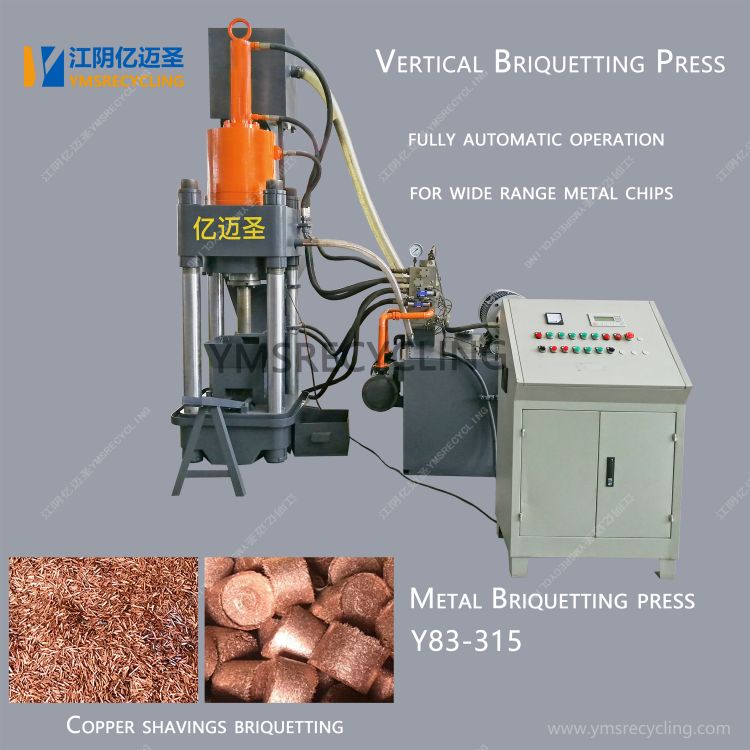
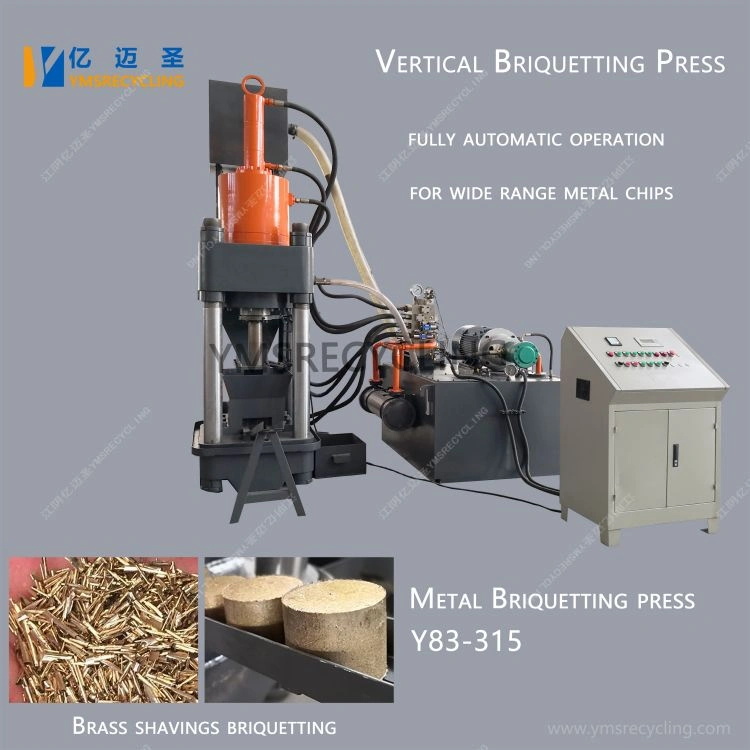
Vertical presses, represented by the Y83 series, use a small footprint and gravity-assisted feeding. The hopper sits directly above the compression chamber, so short chip pieces drop straight into the die with minimal assistance. This layout suits facilities with limited floor space, moderate throughput, and chips that are relatively dry or pre-crushed. The briquette is ejected through a simple die, and the lower structure keeps the entry investment modest.
Horizontal presses, such as the Y83W series, feed chips from one side and push briquettes out the other. That arrangement integrates naturally with inclined conveyors, hoppers, and auger feeders. Long stringy curls and wet chips are easier to handle because pre-compression happens in a horizontal chamber before the main stroke. Throughput is generally higher, which is why large recycling operations tend to select this configuration.
Before choosing a layout, study the difference between vertical and horizontal metal briquetting machines as it applies to your shop floor, since retrofitting after installation is expensive.
For most small and mid-size shops, a vertical Y83 briquetting press is the simplest starting point. A plant with continuous chip flow and an integrated scrap handling line will lean toward a horizontal configuration instead.
Key Specifications to Check Before Buying
Spec sheets look similar across manufacturers, but the numbers that matter are easy to overlook:
- Nominal force in tons. Match it to the hardest material you process. Copper and steel need more force than aluminum.
- Briquette density and dimensions. Density is the truest quality indicator; ask for test reports or on-site trials.
- Cycle time and throughput. Calculate tons per hour from your actual chip bulk density, not from brochure figures.
- Hydraulic system pressure and pump capacity. Operating pressure is meaningless if the cylinder and frame are undersized.
- Coolant drainage. Proper chip pans and drainage channels protect the hydraulic system from contamination.
- Automation level. PLC controls, auto lubrication, and conveyor feed raise the price but reduce labor.
One common purchasing error is sizing the machine for average monthly volume instead of peak weekly flow. Loose chips have a deceptive bulk density; a pile that looks small can overtax a machine rated for a different feed state. Always ask how the manufacturer defines throughput and whether the rating assumes dry crushed material or realistic wet shop-floor turnings.
If copper is part of the mix, the high metal value justifies a dedicated press with a slightly higher force rating. A vertical copper chips briquetting machine is often the best fit for moderate volumes of copper and brass shop waste.
When comparing horizontal lines, manufacturers often present the Y83W horizontal briquetting press line as the higher-automation option, so verify the pre-compression and preshear features against your chip type before deciding.
What a Realistic Decision Looks Like
Start with the material, then the volume, then the layout. If a shop produces one or two tons of aluminum machining chips per week and currently pays for hauling, a vertical hydraulic press will often pay for itself within two years through higher scrap revenue and lower transport cost. If the operation runs around the clock and chips come from several CNC lines, a horizontal machine with conveyor feed is usually worth the added investment.
Put the tonnage and briquette density in writing, ask about the hydraulic component brand, and confirm that the frame and cylinder are rated for continuous duty. A press that stalls on wet steel chips after six months is not a bargain at any price.
The hydraulic briquette press is not a niche tool. It is the standard way to turn a daily waste stream into a saleable material. Buyers who match the machine to their actual chip type, floor space, and peak volume get the shortest payback. Those who shop only on price usually end up paying twice, once for the machine and once for the downtime.