 English
 русский
 Español

A machine shop running three CNC lathes can generate more than a ton of aluminum chips in a week. Those chips pick up coolant, oxidize on the floor, and fill bins faster than anyone wants to deal with. A metal recycling yard has the same problem at a larger scale: low-bulk-density chips cost more to haul, fetch lower prices, and melt with higher losses. Metal briquetting solves this at the source. A hydraulic briquetting press compresses loose shavings, turnings, and borings into dense cylindrical briquettes that are easier to handle, cheaper to transport, and worth visibly more per ton.
Content
- 1 Why Density Changes the Value of Metal Chips
- 2 How a Metal Briquetting Press Works
- 3 Vertical or Horizontal: Which Configuration Fits Your Operation
- 4 Matching the Machine to Your Chip Material
- 5 Briquette Quality: Moisture, Cutting Fluid, and Density Control
- 6 Purchase Considerations: Budget, Integration, and Payback
Why Density Changes the Value of Metal Chips
Scrap buyers discount loose chips because they pay for volume, not just weight. A truckload of loose aluminum shavings carries far less metal than the same trailer full of briquettes, so the freight cost per ton of recoverable metal is high. The large surface area of loose chips also promotes oxidation, and oil-laden chips can carry moisture that causes problems in the furnace. Briquetting addresses all of those issues in a single step: the press force and die shape form a dense, dry, uniform product that behaves more like solid scrap during transport, storage, and melting.
| Property | Loose chips | Pressed briquettes |
|---|---|---|
| Bulk density, steel borings | 0.5–0.7 t/m³ | 1.8–2.2 t/m³ |
| Bulk density, aluminum shavings | 0.2–0.4 t/m³ | 1.4–1.8 t/m³ |
| Freight cost per ton of metal | High | Roughly 60–70% lower |
| Metal recovery at remelting | 70–85% | 92–97% |
| Storage space for the same tonnage | 3–4 times more | Baseline |
Exact values vary with chip form, oil and moisture content, press force, and briquette size, but the commercial direction remains the same. A concentrated input commands a better price, costs less to ship, and yields more metal at the smelter.
How a Metal Briquetting Press Works
All metal briquetting systems follow the same hydraulic cycle. The press meters chips from the hopper into the compression chamber, advances the main cylinder, and compacts the material against a fixed die at a preset pressure. After a short dwell time to let air escape and stress distribute, the press ejects the briquette and starts the next cycle. Full cycles typically take 15 to 60 seconds, depending on press tonnage, briquette diameter, and material type.
Five components matter most when you compare machines:
- Feed system: an auger or inclined conveyor that meters a consistent volume of chips into the compression chamber and prevents bridging at the hopper mouth.
- Main cylinder and hydraulic pump: the source of pressing force, usually rated in tonnage classes such as 100 t, 125 t, or 315 t.
- Die and punch set: defines briquette diameter and density; these are replaceable wear parts with a predictable service life.
- Cooling and filtration system: keeps hydraulic oil at a stable temperature and removes fines that would otherwise damage the pump.
- Control system and interlocks: automatic cycle operation, pressure monitoring, and safety guards that stop the press when a cover is opened.
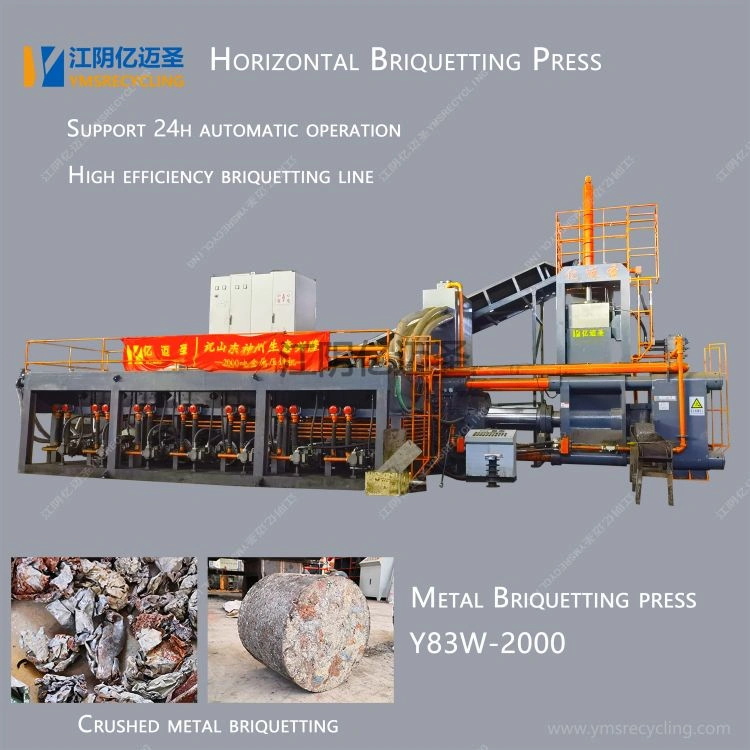
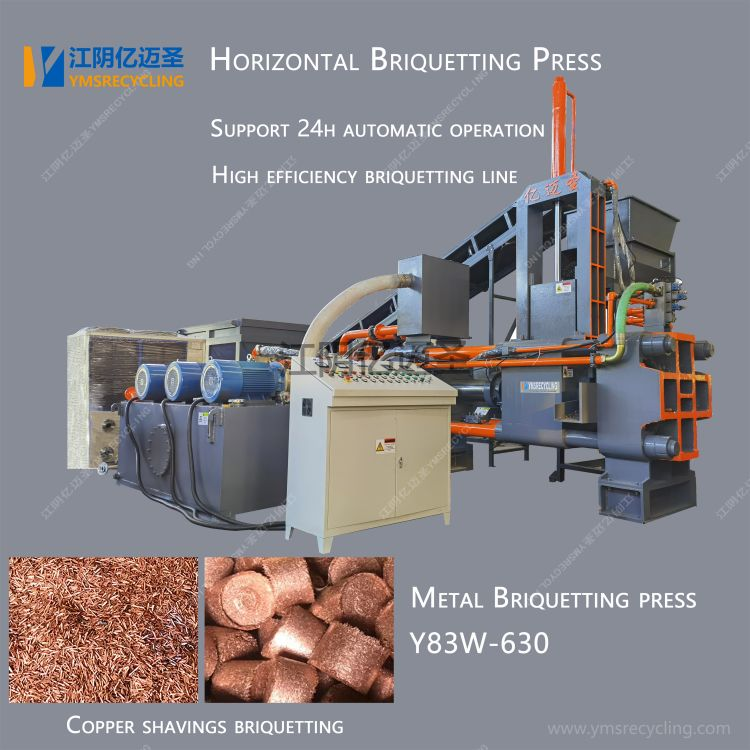
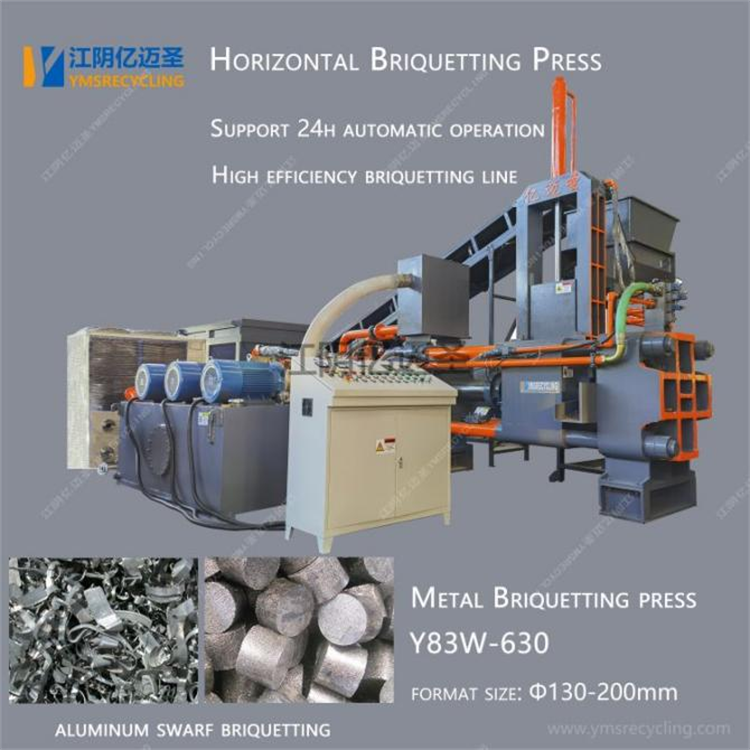
For plants that process steel chips, mixed turnings, or voluminous aluminum shavings, a horizontal machine has practical advantages. The low feed height accepts an inclined conveyor directly from the chip collection point, and the finished briquettes exit at floor level for easy transfer to a drum or bin. The Y83W horizontal briquetting press is built for this kind of continuous material flow, with a screw-fed compression chamber that handles stringy or fluffy chips without constant operator attention.
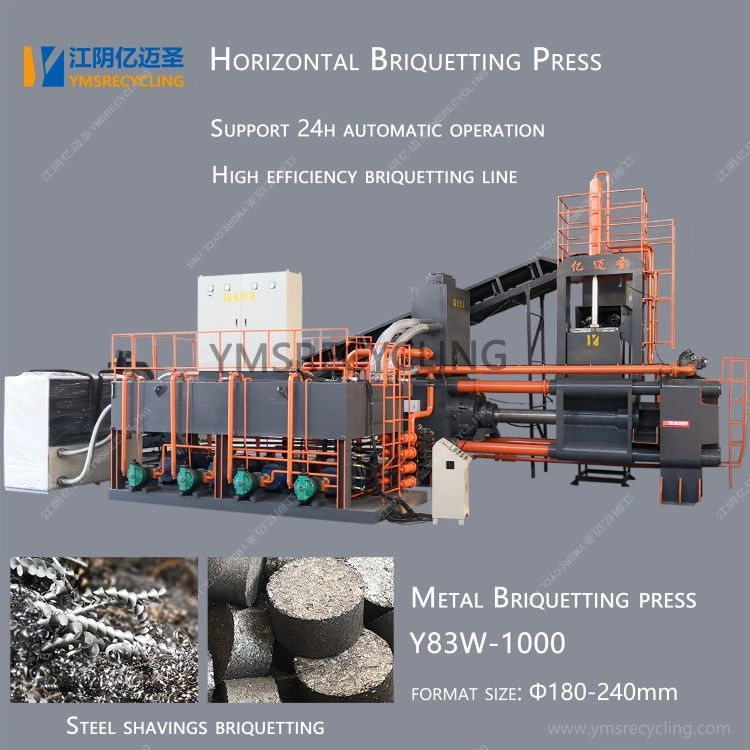 Y83W Horizontal Hydraulic Briquetting Press for Metal ChipsThis horizontal briquetting machine processes steel, aluminum, and copper chips with a screw-fed chamber for continuous flow. Its low feed height and floor-level output suit plants moving material directly from collection points to drums or bins.View Product →
Vertical or Horizontal: Which Configuration Fits Your Operation
The vertical-versus-horizontal decision comes down to your chip volume, available floor space, and how you intend to move material into and away from the press.
Vertical briquetting presses
Vertical machines feed chips through a top hopper and compact them with a downward stroke. The briquette is then pushed upward and out the top, which keeps the pressed density high and the footprint compact. That combination suits machine shops where every square meter counts and chip volumes are moderate. The Y83 vertical briquetting press is the standard starting point for this setup, with a range of tonnage ratings to match different chip loads.
Horizontal briquetting presses
Horizontal presses use a side-mounted cylinder and a longer compression channel. They integrate easily into a continuous production line, accept a conveyor-fed hopper, and deliver briquettes that drop onto an extraction conveyor or into a container. The Y83W horizontal briquetting press follows this layout and suits operations with higher throughput or limited ceiling height.
| Factor | Vertical press | Horizontal press |
|---|---|---|
| Footprint | Compact | Larger |
| Feed height | Top hopper, usually above 1.5 m | Low, conveyor-friendly |
| Typical briquette shape | Cylindrical, solid | Cylindrical or channel |
| Throughput range | 80–500 kg/h | 200–1500 kg/h |
| Best fit | Shops with limited floor space and medium volume | High-volume plants with continuous chip flow |
Specific pressure follows from the cylinder force divided by the piston area inside the die. A vertical machine develops pressure in a straight line from the cylinder to the die face, which gives predictable density across the full briquette cross-section. A horizontal machine at the same rated tonnage usually has a smaller piston area, meaning higher specific pressure, but steady chip feeding becomes more critical. Vertical presses therefore tend to fit smaller operations best, while horizontal presses earn their keep where chips can be fed continuously.
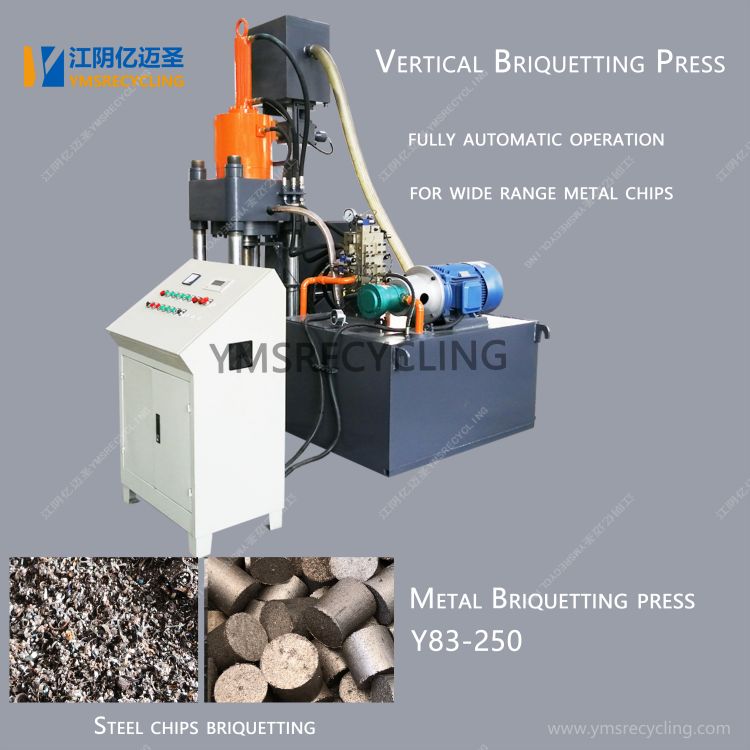 Y83 Vertical Hydraulic Metal Briquetting Machine with PLC ControlA vertical press offering cylindrical briquettes from 25 to 240 mm diameter and capacities up to 2200 kg. Its compact footprint and gravity-assisted feeding fit smaller operations while delivering predictable density across the briquette cross-section.View Product →
Matching the Machine to Your Chip Material
Material type drives the press specification more than any other single factor. Aluminum, copper, brass, and steel each behave differently under compression, and the force, die clearance, and cooling requirement must suit the actual chip stream.
Aluminum chips are light, oxidize quickly, and usually arrive mixed with cutting fluid. The press needs enough force to break the oxide layer and form a coherent briquette, plus a cooling circuit for the heat generated during compression. A vertical aluminum chips briquetting machine is a common choice for machine shops that generate shavings all day and want a briquette dense enough for direct remelting.
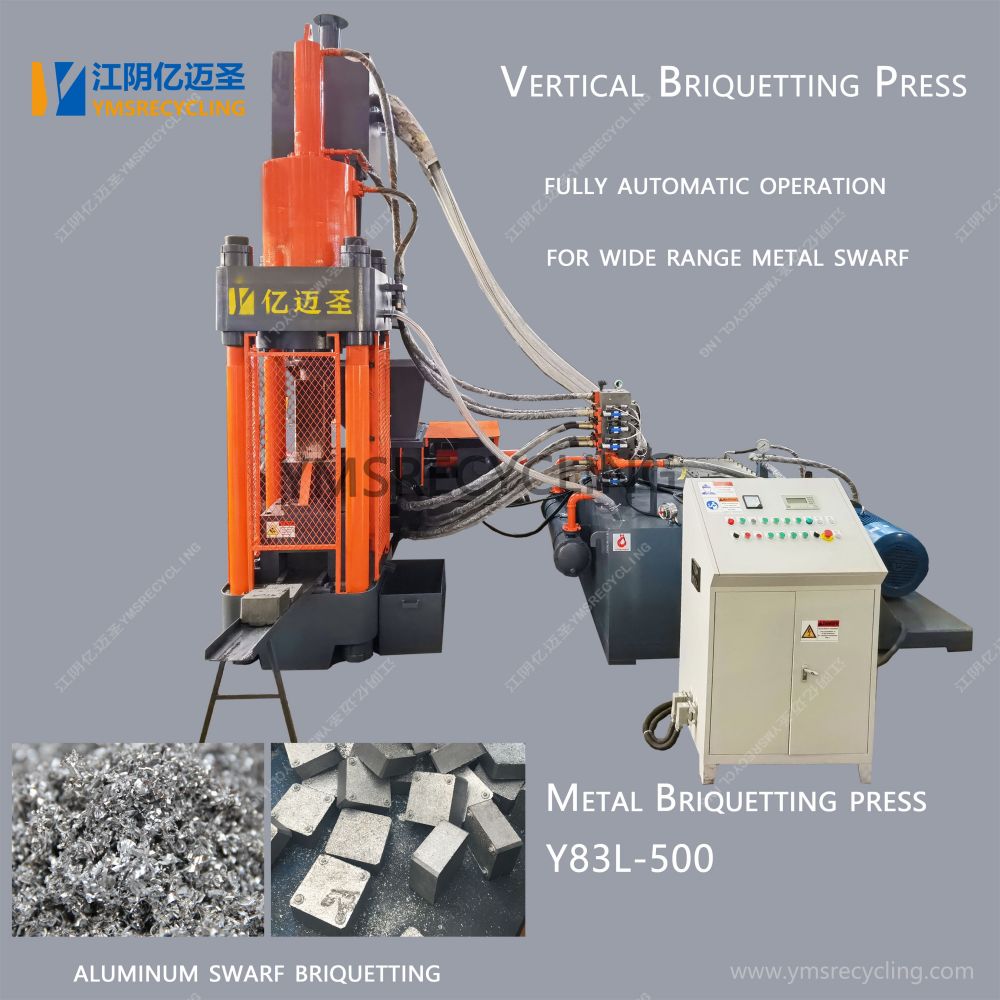 Vertical Aluminum Chips Briquetting Machine for RecyclingThis automated vertical press compacts aluminum shavings into dense briquettes, improving melting efficiency and recovering cutting fluids. It suits machine shops generating continuous shavings and wanting direct-remelt output with minimal operator involvement.View Product →
Copper and brass chips are heavier and behave differently in the feed auger; they need a feed system that moves material without jamming and a die that survives abrasive wear over years of service. Steel chips and borings are the most abrasive of all. They call for hardened dies, reinforced punches, and a maintenance schedule built around predictable die wear.
A practical rule: specify the machine for the heaviest and most abrasive material you plan to run regularly. A press sized for aluminum will struggle with steel, while a press sized for steel processes aluminum comfortably with a different die setup.
Briquette Quality: Moisture, Cutting Fluid, and Density Control
Briquette quality is a commercial matter, not a cosmetic one. Density and residual moisture determine how the briquette behaves inside a furnace and how much it is worth on the scrap market.
Moisture is the most common problem in chip briquetting. Cutting fluid trapped in the chip stream ends up inside the briquette, lowering density and creating steam or flare-ups during melting. A well-set briquetting press expels part of the cutting fluid during compression, but operations that pre-drain chips in a chip wringer or centrifuge consistently produce better briquettes and recover more fluid for reuse.
Climate matters, too. In humid regions, check that the hydraulic system is sealed against condensation and that the control panel has adequate protection ratings. As a density target, plan for a briquette that reaches 80 to 85 percent of solid material density. Lower values usually mean insufficient force or a feed problem; higher values can indicate a die clearance that is too tight, which accelerates wear on the press tooling.
Purchase Considerations: Budget, Integration, and Payback
Before requesting a quote, define three numbers: your weekly chip output in tonnes, the target briquette density required by your buyer or melting process, and the available space and power at the installation point. These determine the tonnage, cycle time, and hopper capacity you actually need.
Installation cost is often underestimated. The press needs a level reinforced floor, a three-phase power connection, hydraulic oil cooling, and a reliable way to get chips to the hopper, whether by screw conveyor, pneumatic system, or manual charging. Add the cost of a centrifuge if your chip stream is wet, and budget for the hydraulic system's electrical load during continuous operation.
Payback is usually favorable. A press that raises the value of aluminum chips by several hundred dollars per tonne, while cutting freight and storage costs, can recover its own purchase price within 12 to 24 months even at moderate throughput. Larger operations with a dedicated chip line often see faster returns because the economics scale directly with volume.
Whichever press class you choose, look for accessible wear parts, standard hydraulic components, and documentation that includes a pressure chart for the materials you plan to run. Those details separate a dependable production tool from a prototype.
Metal briquetting is not a new technology, but it remains one of the most reliable upgrades a metalworking shop or recycling operation can make. The right press turns a messy, low-value by-product into a dry, dense, sellable material while recovering cutting fluid and reducing storage overhead. Start with a realistic density and throughput target, match the machine to your heaviest material, and the payback will usually follow.