 English
 русский
 Español

The two primary categories of metal briquetting presses are hydraulic and mechanical systems. Each offers distinct advantages and disadvantages depending on the material being processed, production volume requirements, and operational constraints. Additionally, within these categories, manufacturers must choose between vertical and horizontal configurations, each suited for different space constraints and production scales.
This comprehensive guide examines the key differences between hydraulic and mechanical metal briquetting presses, compares vertical and horizontal configurations, and provides detailed analysis of how different metal materials affect the briquetting process. By understanding these distinctions, facility managers, plant engineers, and recycling professionals can make informed decisions that optimize their operations, reduce costs, and improve recycling outcomes.
Content
- 1 Understanding the Core Operating Principles
- 2 Head-to-Head Comparison: Hydraulic vs Mechanical Systems
- 3 Vertical vs Horizontal Metal Briquetting Press Configurations
- 4 Material-Specific Considerations for Metal Briquetting
- 5 Economic Benefits of Metal Briquetting
- 6 Selection Guide for Metal Briquetting Presses
- 7 Conclusion
- 8 Frequently Asked Questions
- 9 References
Understanding the Core Operating Principles
Hydraulic Metal Briquetting Press
A hydraulic metal briquetting press utilizes a hydraulic cylinder driven by a pump to generate compression force. The ram moves slowly but delivers extremely high pressure, often exceeding 2000 psi, allowing it to densify materials that are difficult to compact. The system includes an accumulator and proportional valves to control pressure and stroke rate. Because hydraulic fluid absorbs shock, these machines can handle variable feed consistency without sustaining mechanical damage.
The hydraulic system operates by converting mechanical energy from an electric motor into hydraulic fluid pressure. This pressurized fluid then drives the piston, which applies force to the material being compressed. The pressure can be precisely controlled and maintained throughout the compression cycle, resulting in uniform briquette density.
Mechanical Metal Briquetting Press
Mechanical metal briquetting presses rely on a flywheel, eccentric mechanism, or screw press to deliver rapid, repetitive strokes. A large flywheel stores kinetic energy and releases it in a quick punch, creating briquettes at a much higher cycle rate, typically 50 to 200 strokes per minute, compared to hydraulic systems which operate at 1 to 5 strokes per minute. Mechanical presses are generally simpler in hydraulic circuit design but require precise mechanical alignment and heavier structural frames to withstand impact forces.
The mechanical system operates through an electric motor that drives a flywheel. The flywheel stores energy and releases it through an eccentric mechanism or connecting rod, converting rotational motion into linear pressing action. This design allows for very high-speed operation but provides less control over pressure throughout the compression stroke.
Head-to-Head Comparison: Hydraulic vs Mechanical Systems
To facilitate informed decision-making, the following table summarizes the critical differences between hydraulic and mechanical metal briquetting presses across key performance parameters.
| Parameter | Hydraulic Briquetting Press | Mechanical Briquetting Press |
|---|---|---|
| Briquette Density | Uniform, high-density (up to 1.8–2.0 g/cm³ for metal swarf) | Slightly lower density (1.4–1.6 g/cm³) with some variation |
| Production Speed | 30–60 briquettes per hour | 150–300 briquettes per hour |
| Energy Efficiency | 70–80% overall efficiency | 90–95% efficiency |
| Maintenance Complexity | Regular oil changes, filter replacements, seal inspections | Bearing lubrication, belt tensioning, flywheel alignment |
| Material Flexibility | Handles oily, wet, or inhomogeneous materials | Best with dry, consistent, low-moisture materials |
| Noise Level | 65–75 dB (quieter operation) | 85–95 dB (higher impact noise) |
| Operating Life | Moderate lifespan | Considerably longer operating life |
| Typical Application | Small to medium-scale, variable materials | Large-scale, high-volume, uniform materials |
Briquette Density Analysis
Hydraulic presses achieve superior briquette density because pressure is sustained throughout the entire compression cycle. This sustained pressure allows for more complete compaction of the material, particularly important for metals that require significant force to achieve plastic deformation. For metal chips, hydraulic presses can achieve densities up to 2.0 g/cm³, approaching the theoretical density of solid metal.
Mechanical presses, while operating at much higher speeds, have a shorter dwell time at maximum pressure. This results in briquette densities that are typically 5 to 15 percent lower than those produced by hydraulic systems, depending on the material being processed. The impact-based compression of mechanical presses can sometimes create density variations within individual briquettes due to the rapid nature of the pressing cycle.
Production Speed and Throughput
The production speed advantage of mechanical presses is significant for high-volume operations. A typical 55-ton mechanical press can produce 150 to 300 briquettes per hour, while a comparable hydraulic unit produces only 30 to 60 briquettes per hour. For facilities processing 10 or more tons of metal chips per day, mechanical systems often provide lower per-ton capital costs due to their higher throughput.
However, it is important to note that hydraulic presses can be designed with multiple compression stations or larger cylinder sizes to increase throughput. Some high-capacity hydraulic systems can process up to 5000 kg per hour for certain materials. The choice between hydraulic and mechanical for high-volume applications depends on the specific material characteristics and the desired briquette quality.
Energy Consumption Considerations
Energy efficiency is a critical factor in the overall operating cost of a metal briquetting press. Mechanical presses typically achieve 90 to 95 percent efficiency because the flywheel stores and releases energy directly, with minimal conversion losses. The flywheel acts as an energy storage device, smoothing out power demand and allowing for more efficient use of the electric motor.
Hydraulic systems have an overall efficiency of 70 to 80 percent due to pump and valve losses. The conversion of mechanical energy to hydraulic pressure and back to mechanical force introduces multiple points of energy loss. However, when hydraulic units are equipped with variable-speed drives, the efficiency gap narrows significantly.
Maintenance Requirements
Maintenance considerations differ substantially between the two technologies. Hydraulic machines require regular oil changes, filter replacements, and seal inspections. Hydraulic fluid leaks are a common pain point that requires vigilant monitoring and prompt repair. The hydraulic system also requires periodic cleaning of reservoirs and replacement of hydraulic hoses and fittings.
Mechanical presses have fewer hydraulic components, reducing complexity in that area, but they require periodic bearing lubrication, belt tensioning, and flywheel alignment. The mechanical components experience significant impact forces and wear over time, requiring regular inspection and replacement of wear parts. Both designs demand skilled technicians for proper maintenance, but mechanical systems are generally considered easier to troubleshoot.
Material Flexibility and Compatibility
Hydraulic presses excel in handling challenging materials. They can process oily, wet, or inhomogeneous materials such as shredded aluminum with coolant without jamming. The hydraulic system can slow down or stop if overloaded, protecting both the machine and the material being processed. This flexibility makes hydraulic presses the preferred choice for facilities processing mixed or contaminated metal scrap.
Mechanical presses perform best with dry, consistent, low-moisture materials. Sticky or irregular feed can cause blockages or result in uneven briquettes. The high-speed, impact-based compression of mechanical presses is less forgiving of variations in material properties. Facilities processing clean, uniform metal chips from controlled machining operations are well-suited for mechanical presses.
Noise and Vibration
The operating environment is an important consideration for many facilities. Mechanical machines generate higher impact noise, typically 85 to 95 decibels, and significant structural vibration. This can require additional soundproofing measures and may impact worker comfort and safety. The vibration from mechanical presses can also transmit through floors and structures, potentially affecting nearby sensitive equipment.
Hydraulic systems operate much quieter at 65 to 75 decibels with smoother compression. The hydraulic fluid absorbs shocks and dampens vibrations, resulting in a more pleasant working environment. This makes hydraulic presses preferable for indoor installations, particularly in facilities where noise restrictions apply or where multiple machines operate in close proximity.
Vertical vs Horizontal Metal Briquetting Press Configurations
Beyond the hydraulic versus mechanical distinction, metal briquetting presses are also categorized by their structural configuration: vertical and horizontal designs. Each configuration offers distinct advantages for different applications and facility layouts.
Vertical Metal Briquetting Press
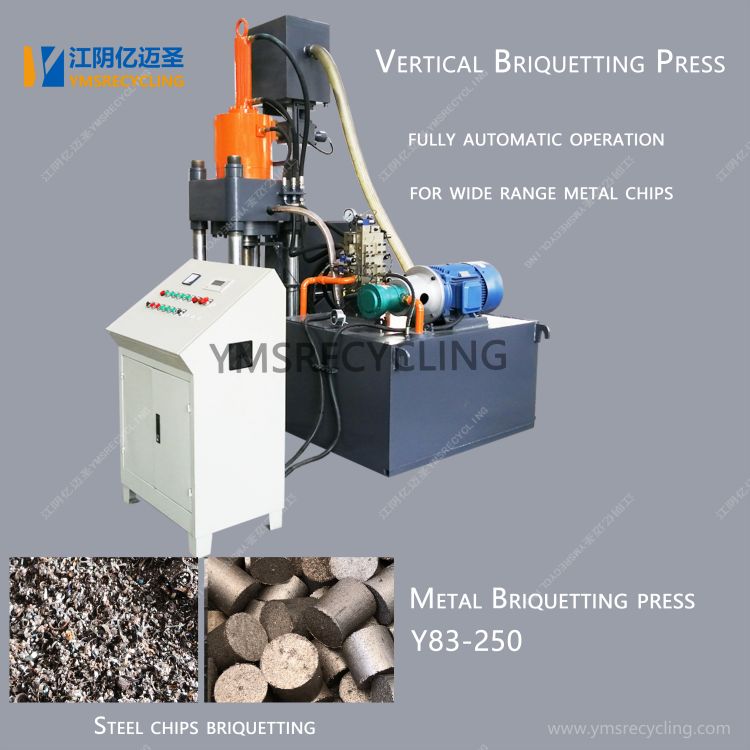
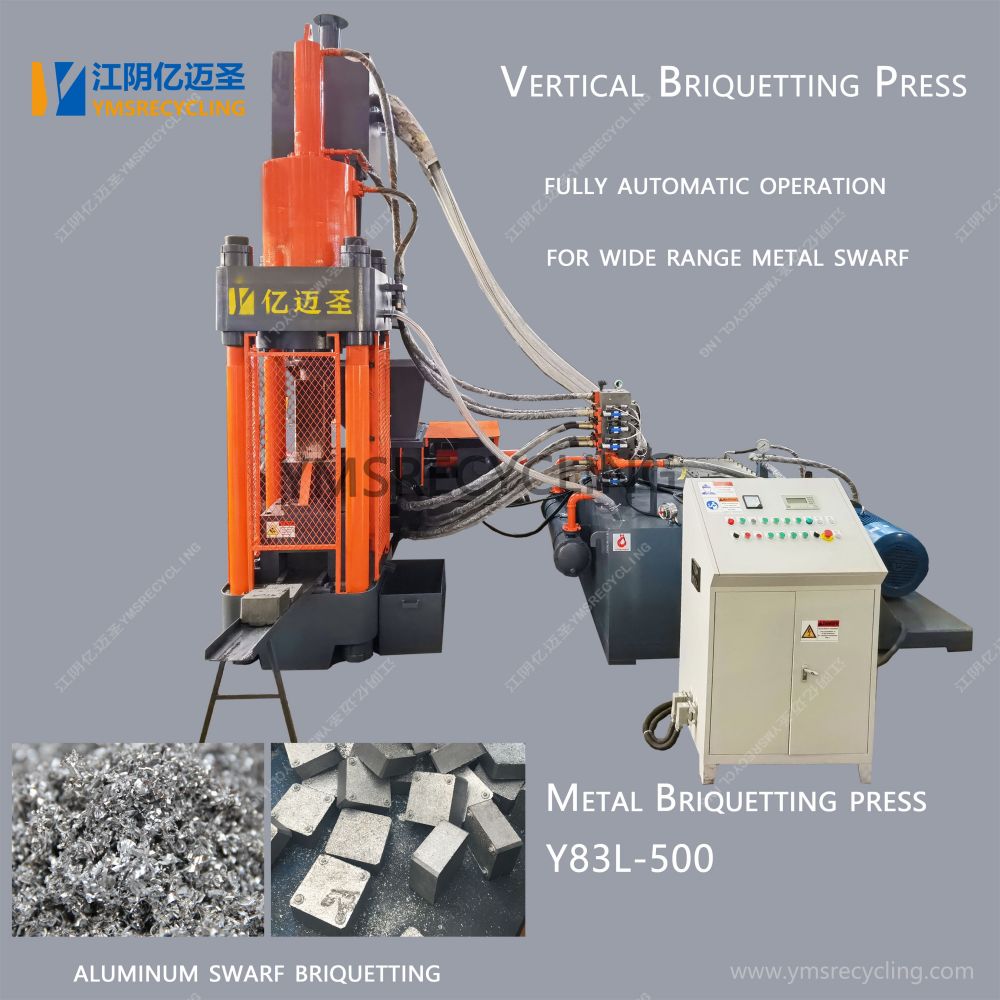
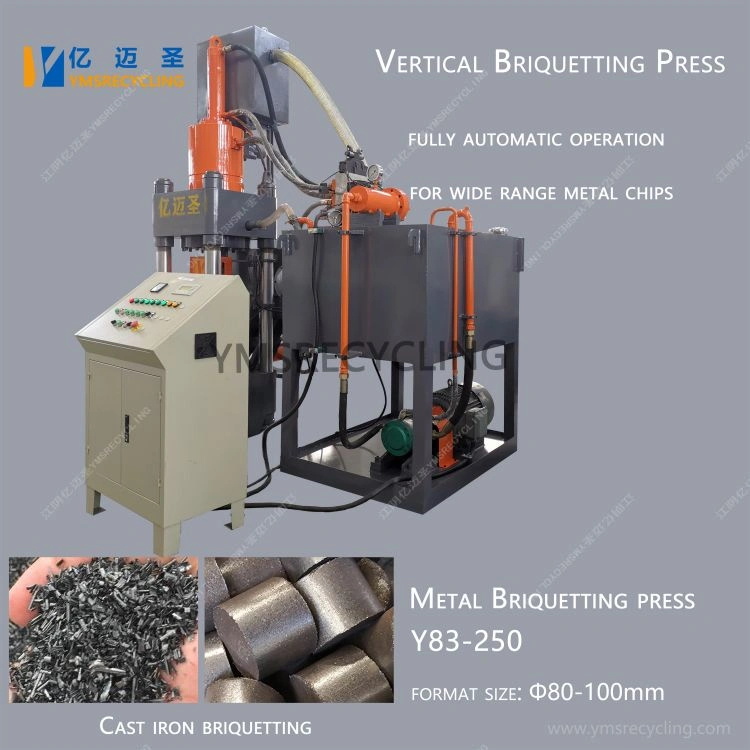
Vertical metal briquetting presses feature a compact design with a small footprint, making them ideal for facilities with limited space. The vertical configuration uses a downward pressing stroke, with the material loaded from the top and the briquette ejected from the bottom. This design takes compactness and high efficiency as the core design principles.
Key advantages of vertical presses include:
Simplified structure and small floor area requirements, with no need to embed anchor screws during installation
Outstanding stress uniformity during compression, resulting in low wear on components
Flexible mould replacement that can synchronously form multi-specification products
Suitability for small batch and multi-category production modes
Vertical presses are primarily applicable to the compression treatment of low-hardness metal chips such as iron chips, aluminum chips, and copper chips, as well as metal powder. They require that large waste materials be pre-crushed to the appropriate size. Typical application scenarios include small and medium-sized mechanical processing plants or recycling sites, particularly in working environments with limited space and scattered waste categories.
Horizontal Metal Briquetting Press
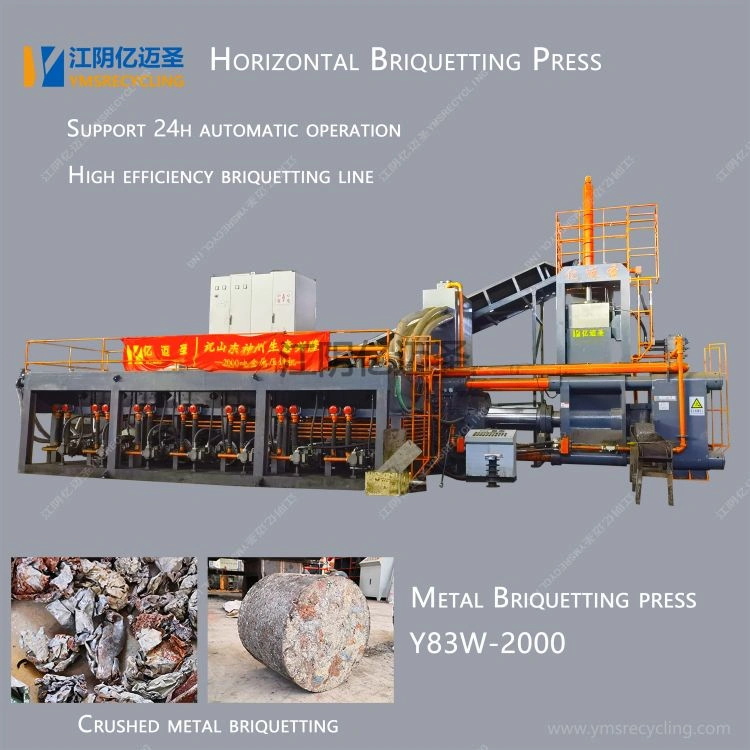
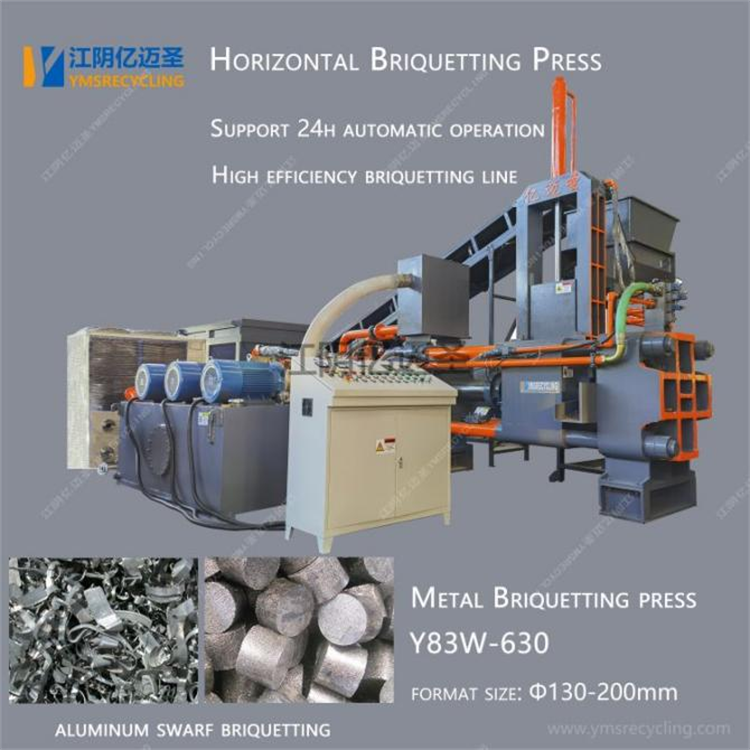
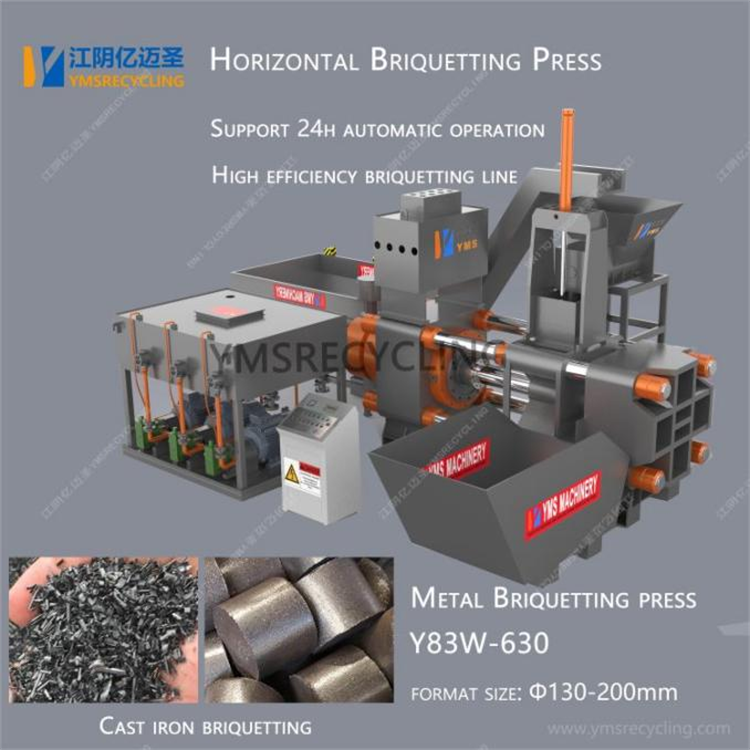
Horizontal metal briquetting presses take high-strength compression as their technical highlight, with some models achieving pressures up to 2000 tons. The horizontal configuration applies force laterally, with the material fed from one end and the briquette ejected from the opposite end.
Key advantages of horizontal presses include:
Significantly improved briquetting density through high-pressure compression
Ability to mix and compress metal chips and debris without pre-sorting
Compatibility with automated production lines, with daily capacity exceeding 300 tons
Full hydraulic drive combined with PLC control systems for operational stability and low failure rates
Compatibility with complex materials such as low and high hardness metal chips including steel chips and titanium chips, as well as oil and coolant-contaminated chips
Ability to directly process mixed waste of large metal pieces and chips without pre-crushing
Horizontal presses primarily serve large-scale recycling enterprises and steel mills, meeting the high-capacity demands of automotive, electronics, and other industries. The compressed briquettes from horizontal presses are easier to transport and smelt, effectively achieving cost reduction and efficiency enhancement.
Configuration Selection Guidelines
The choice between vertical and horizontal configurations should be based on several factors:
Space availability: Vertical presses require less floor space and are suitable for cramped areas
Production volume: Horizontal presses generally offer higher throughput and are better suited for large-scale operations
Material characteristics: Horizontal presses can handle a wider range of materials, including mixed and contaminated scrap
Automation requirements: Horizontal presses are more readily integrated into fully automated production lines
Investment budget: Vertical presses typically have lower initial investment costs
Material-Specific Considerations for Metal Briquetting
Different metals exhibit different behaviors during the briquetting process, requiring specific considerations for optimal results.
Aluminum Chips
Aluminum chips are soft and porous, making them relatively easy to briquette. The critical pressure for aluminum chip briquetting is only 12 to 16 MPa, significantly lower than for other metals. Aluminum chips are typically lightweight and occupy large volumes, making volume reduction particularly valuable.
Briquetting aluminum offers significant advantages: briquettes melt better than loose chips, and when comparing the same weight of briquettes versus chips, briquettes produce more aluminum after being melted. Loose chips tend to burn during melting, while briquettes melt more like solid metal, improving recovery rates. Aluminum briquetting can achieve volume reductions of up to 10:1.
Steel and Cast Iron Chips
Steel and cast iron chips are heavier and can take very different forms depending on the machining operation, including long ribbons, short chips, and spirals. They require more compaction force than aluminum but handle the heat generated during the process well.
Cast iron chips are hard and sharp, with the critical pressure reaching 28 to 35 MPa. Stringy steel turnings often require shredding or crushing before efficient briquetting. The density of steel and cast iron briquettes typically ranges from 0.57 to 0.66 of solid metal density.
Cast iron briquettes can replace pig iron as raw material in foundries, providing significant cost savings and reducing reliance on virgin materials.
Copper and Brass Chips
Copper and brass chips present unique challenges due to the high value of the material and the specific properties of copper alloys. Copper chips are dense and require substantial pressing force to achieve adequate briquetting density. The high value of copper makes efficient recovery particularly important, and briquetting can significantly improve the resale value of copper scrap.
Stainless Steel and Titanium
Stainless steel powder and titanium chips are among the most challenging materials to briquette. The ductility of stainless steel powder is very poor, requiring pressures exceeding 40 MPa. Without adequate pressure, stainless steel briquettes are very easy to break up. Titanium presents similar challenges due to its high strength and low ductility at room temperature.
Selection by Material Type
When selecting a metal briquetting press, the material being processed is the primary consideration. Hard metal chips such as steel and iron require high-pressure models to avoid loose briquettes. Soft metal chips such as aluminum can be processed with lower-pressure equipment but benefit from the sustained pressure of hydraulic systems for optimal density.
Economic Benefits of Metal Briquetting
Metal briquetting offers substantial economic benefits that justify the investment in briquetting equipment. These benefits include:
Fluid Recovery: Metal briquetting presses can recover up to 97 percent of expensive fluids, including both water-based and oil-based coolants. This recovery can result in annual savings of over one million dollars for large manufacturing operations.
Increased Scrap Value: Briquetting can increase scrap resale prices by 10 to 30 percent. The densified briquettes are more valuable to recyclers because they melt more efficiently and produce higher yields.
Volume Reduction: Briquetting significantly reduces material volume, often to a fraction of the original size. Volume reductions of up to 90 percent are common, dramatically reducing storage space requirements and transportation costs.
Reduced Handling Costs: The compact briquettes are easier to handle, store, and transport than loose chips. This reduces labor costs and improves workplace safety by eliminating the hazards associated with loose, sharp metal chips.
Environmental Compliance: Briquetting reduces the environmental impact of metalworking operations by containing fluids and reducing waste volume. This helps facilities meet environmental regulations and sustainability goals.
Selection Guide for Metal Briquetting Presses
When selecting a metal briquetting press for your facility, consider the following factors in order of priority:
Material Characteristics
The type of metal chips being processed is the most important selection criterion. Consider the material hardness, chip form (stringy, short, or powdery), moisture content, and the presence of cutting fluids or coolants. Hard metals require higher pressing forces, while soft metals may be processed with lower-pressure equipment.
Production Capacity Requirements
Determine the required processing capacity based on the volume of metal chips generated. Small recycling points may be served by semi-automatic models below 200 tons, while large operations require fully automatic, high-capacity systems. Consider both current needs and potential future growth.
Automation Level
Decide whether a fully automated, semi-automated, or manual press is appropriate for your operation. Fully automated systems reduce labor requirements and improve consistency but require higher initial investment. Semi-automated systems offer a balance of cost and functionality for many medium-sized operations.
Available Space
Evaluate the available floor space and ceiling height in your facility. Vertical presses require less floor space and are suitable for cramped areas, while horizontal presses require more space but offer higher capacity.
Budget Constraints
Consider both the initial capital investment and the long-term operating costs. Mechanical presses typically have lower purchase prices, while hydraulic presses may offer lower operating costs for certain applications. Factor in maintenance costs, energy consumption, and the value of recovered fluids when calculating total cost of ownership.
Regulatory Requirements
Consider any regulatory requirements that may apply to your operation, including CE certification for European markets or UL certification for North American markets. While certification increases costs, it significantly enhances export competitiveness and ensures compliance with safety standards.
Conclusion
The choice between hydraulic and mechanical metal briquetting presses depends on a careful evaluation of material characteristics, production requirements, and operational constraints. Hydraulic presses offer superior briquette density, material flexibility, and quieter operation, making them ideal for facilities processing variable or contaminated materials. Mechanical presses provide higher production speeds, better energy efficiency, and lower maintenance complexity, making them preferred for high-volume operations with consistent, clean materials.
Similarly, the choice between vertical and horizontal configurations should be based on space availability, production volume requirements, and the specific materials being processed. Vertical presses offer compact design and flexibility for small to medium operations, while horizontal presses provide high-capacity processing for large-scale recycling operations.
By understanding these differences and carefully evaluating your specific requirements, you can select a metal briquetting press that optimizes your recycling operations, reduces costs, and maximizes the value of your metal waste streams.
Frequently Asked Questions
Q1: What is the main difference between hydraulic and mechanical metal briquetting presses?
The main difference lies in the drive mechanism. Hydraulic presses use fluid pressure to generate compression force, providing sustained pressure throughout the compression cycle for uniform, high-density briquettes. Mechanical presses use a flywheel and eccentric mechanism to deliver rapid, repetitive strokes at much higher speeds, typically 50 to 200 strokes per minute compared to 1 to 5 strokes per minute for hydraulic systems.
Q2: Which type of metal briquetting press is better for processing oily or wet metal chips?
Hydraulic metal briquetting presses are better suited for processing oily or wet metal chips. The hydraulic system can handle variable feed consistency without jamming, and the hydraulic fluid absorbs shock, protecting the machine from damage. Mechanical presses perform best with dry, consistent, low-moisture materials.
Q3: What factors should I consider when choosing between a vertical and horizontal metal briquetting press?
Consider available floor space (vertical presses require less space), production volume requirements (horizontal presses offer higher capacity), material characteristics (horizontal presses can handle a wider range including mixed scrap), automation requirements (horizontal presses integrate more readily into automated lines), and investment budget (vertical presses typically have lower initial costs).
Q4: How much can metal briquetting reduce the volume of metal chips?
Metal briquetting can achieve significant volume reductions, typically up to 90 percent for materials like aluminum. For some metals, the volume can be reduced to as little as one-tenth of the original volume. This dramatic reduction lowers storage space requirements, reduces transportation costs, and improves handling efficiency.
Q5: What is the typical density of briquettes produced by hydraulic versus mechanical presses?
Hydraulic presses typically achieve briquette densities of 1.8 to 2.0 g/cm³ for metal swarf, with sustained pressure throughout the compression cycle ensuring uniform density. Mechanical presses produce briquettes with slightly lower densities of 1.4 to 1.6 g/cm³, with some variation due to the shorter dwell time at maximum pressure. The density difference is typically 5 to 15 percent depending on the material.
References
-
Hydraulic vs Mechanical Briquetting Machine: Pros and Cons Compared - Technical comparison of hydraulic and mechanical briquetting systems including operating principles, performance metrics, and maintenance requirements
-
Comparison of Mechanical and Hydraulic Briquetting Presses - Analysis of drive system differences, efficiency considerations, and application-specific recommendations for briquetting equipment
-
Guide for selection of metal briquetting equipment - Comprehensive selection guide covering vertical versus horizontal configurations, material compatibility, and application scenarios
-
Metal Briquetting Machines for Sale - Overview of economic benefits including fluid recovery up to 97 percent, increased scrap value, and volume reduction capabilities
-
Briquetting presses for efficient metal recycling - Technical specifications including throughput capacities from 30 to 5,000 kg per hour and briquette density data for various metals